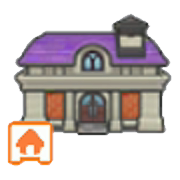
A building assembled by hand can become a home without a construction kit. The game must recognize an enclosed room, however: a large attractive shell is not automatically one valid house. Build and test a small room before expanding the design.

Test one simple room first
- Enclose an interior of at least 2 by 2 squares with continuous walls at least one block high. A 1-by-4 strip is not equivalent. Keep the test room within a 10-by-9 interior footprint.
- Fit a door into the perimeter at the room's floor level. Close gaps around it and check the enclosure before hiding the edges behind decorations.
- Place at least three different furniture or decoration items inside. Bring a following Pokémon close and use the move-in dialogue, or place a Ditto flag nearby to make it your home.
Separate a large design into recognized spaces
If the outer building is too large, add internal partitions and doors instead of expecting the whole open hall to count. Keep each intended room within the supported footprint and test recognition as you add it. On another floor, create a complete enclosed space with its own usable entrance; a ceiling or staircase alone does not prove that the upper level counts as a separate home.
Know which building rules still apply
A roof is optional for basic house recognition, though it changes shade and appearance. Three copies of the same chair do not replace three different furnishings. Handmade block houses also cannot be packed with relocation kits or removed with demolition kits: moving the design requires rebuilding its blocks.